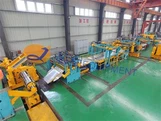
Steel Sheet Slitting Line
Description
Technical Parameters
What is Steel Sheet Slitting Line
A Steel Sheet Slitting Line is a mechanical system that is designed to cut or slit large metal coils into smaller strips of a certain width. This process is used to produce metal strips that are used in the construction of various industrial and commercial products such as roofing materials, automotive parts, electronic components, HVAC equipment, and more. The steel sheet slitting line consists of a decoiler, a slitter, a recoiler, and other accessories that work together to cut the metal coil into smaller strips of a specific width. The steel sheet slitting line is a highly automated and efficient system that offers precision cutting and high-speed production capabilities.
Why choose us?
Rich Experience
The company has professional engineering and technical personnel in hydraulic and electrical machinery and a relatively complete quality assurance system, and constantly develops today's advanced product structures and new processes, new materials, and new technologies.
Quality Control
Provide high-quality products to users at home and abroad, design and produce non-standard products according to user needs, and provide complete design, manufacturing and technical consulting services.
Good service
We offer a comprehensive customization solution, tailored to meet the specific needs and requirements of our clients.
One-stop Solution
Providing technical support, troubleshooting, and maintenance services.




Advantage Of Steel Sheet Slitting Line
Steel Sheet Slitting Line is a device used to cut steel plates into strips longitudinally. It has the following advantages:
(1) Efficiency: The slitting steel plate slitting machine can quickly and accurately complete the cutting of steel plates and improve production efficiency. It can process a large number of steel plates in a short time and is suitable for mass production.
(2) Accuracy: This machine is able to achieve high-precision cutting, ensuring that each cut steel bar has the same size and shape. This is important for steel plate machining tasks that require precise dimensions.
(3) Flexibility: The slitting steel plate slitting machine can be adjusted as needed to accommodate steel plates of different sizes and thicknesses. It has great adaptability and can meet different processing requirements.
What Are the Primary Applications of Slit Steel Coils?
Steel slitting is a metalworking process that involves cutting large coils of steel into narrower strips. This is done with the use of very specialized equipment such as a steel slitting machine and slitting knives. The primary applications of steel slitting include:
Construction industry: Steel slitting is widely used in the construction industry for manufacturing various products such as roofing sheets, wall panels, and ceiling tiles. The narrow strips produced through steel slitting can be used to create flat sheets of steel that are suitable for these applications.
Automotive industry: Steel slitting is also used in the automotive industry for manufacturing parts such as door frames, seat brackets, and fenders. The narrow strips produced through steel slitting are ideal for creating these parts as they can be easily shaped and welded.
Electrical industry: Steel slitting is used in the electrical industry for manufacturing transformer cores, motor cores, and laminations. The narrow strips produced through steel slitting are ideal for creating these products as they can be easily stacked and assembled.
Packaging industry: Steel slitting is used in the packaging industry for manufacturing metal packaging products such as cans and containers. The narrow strips produced through steel slitting can be easily formed and welded to create these products.
Operating Procedure For Steel Coil Plate Slitting Line
Introduction:
Steel coil plate slitting line is a sophisticated manufacturing process and hence requires proper operating procedures for safe and efficient working. The following is a step-by-step operating procedure for the steel coil plate slitting line.
Step 1: Prepare the steel coil plate
The steel coil plate should be inspected to ensure it is of the required dimension and quality. The edges should be smooth, and there should be no visible defects. The coil should be loaded onto the uncoiler, which will then lift the coil and pass it through the straightener.
Step 2: Straightening and cutting
The uncoiler feeds the coil to the straightener where it is flattened and tensioned. Once the coil is flat enough, it is passed through the leveller and cut into the desired length or dimension.
Step 3: Slitting
After cutting the steel coil plate, it is passed through the slitter where the steel is slit into smaller strips of the required width. The slitting process requires that the incoming steel be guided, and hence the system is fitted with rollers that hold the steel in place.
Step 4: Seperating and recoiling
The slitted strips are then separated and recoiled on the mandrel. The inner and outer diameters of the mandrel need to be set correctly to ensure the strips are recoiled correctly.
Step 5: Finishing
The strips are then passed through the stacking table, where any remaining defects are removed, and the strips are stacked neatly for transportation.
Conclusion:
The operating procedure outlined above is critical in ensuring a smooth and efficient manufacturing process of steel coil plates. The process requires skilled operators, and safety measures need to be observed at all times. It is important to follow the procedures to prevent accidents and to produce high-quality steel products.
What to Do After The Slitting Line is Energized?
After a slitting line is energized, the following steps should be taken:
1. Ensure that all safety measures and procedures are in place and followed.
2. Check that all components of the slitting line are functioning properly.
3. Set speed and tension according to the specifications of the material being processed.
4. Align the material correctly and feed it into the slitting line.
5. Monitor the output and make adjustments as necessary.
6. Inspect the slits for quality and accuracy.
7. Label and package the finished products appropriately.
8. Shut down the slitting line in a safe and proper manner once production is complete.
What Goes Into Steel Slitting Process?
Steel slitting involves several steps:
Coil loading: The process begins by loading a coil of steel onto an uncoiler machine. The coil is typically unwound using a motorized system that feeds the steel into the slitting line.
Slitting: The slit coil is then passed through the slitter head where a series of rotating circular blades cut the coil into narrower strips. The number of blades used and the gap between them will determine the width of the strips produced. Precise tooling is used in the set up between the knives to produce the specified width(s).
Recoiling: From the slitter head the strips are then secured into the recoiler. The recoiler rotates and the newly slit coils are produced as it pulls the strips from the slitter head.
Quality control: Throughout the process, quality control measures are taken to ensure that the finished product meets the required specifications. This involves measuring the width and thickness of the strips, inspecting the surface for defects, and testing the strength and durability of the steel.
Steel slitting is a complex manufacturing process that requires precision equipment, skilled operators, and rigorous quality control measures to ensure that the finished product meets the required specifications.
The Functions of Several Main Components in the Slitting Line are Introducted in the Following
Coil slitting lines are often referred to as slitting lines or sheet cutting lines. This is a metalworking line that cuts wide steel coils into narrower or shorter strips. Although known as a coil slitting line, this processing line is sometimes used to process coils of sheet metal other than steel. That said, stainless steel is the most common material in the slitting line process. The shorter or narrower strip will go to other metal processing lines to produce the final product.
Coil slitting machines are sometimes also called cut-to-length slitters; coil slitting lines are therefore also called cut-to-length slitting lines. In such a process, the coil slitter plays a key role as it is responsible for cutting the main coil into several coils. In some cases, slitters work with coilers at the last station of the line to collect rewinds and sort them into rolls, which is why slitters are called roll-to-roll slitters.
Depending on the material, the workload and the application for setting the slitting line, the coil slitting line can consist of multiple machines with automatic control systems, or it can be a simple slitting machine where the main coil is manually operated by the operator feeding. For simple manual slitters, the entire slitting operation is done on the workbench. For heavy-duty slitting lines for mass production, there are safety or guide accessories such as uncoilers, coil feeders, slitters, press cutters, winders, etc. on the line.
The functions of several main components in the slitting line are introducted in the following.
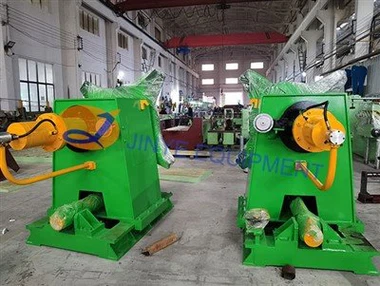
Uncoilers are sometimes referred to as decoilers. It usually works with a coil feeder to insert sheet metal into a slitter. An uncoiler, as the name suggests, unwinds sheet metal from a coil car and feeds it to a coil feeder. The coil feeder is used to flatten the main coil and ensure that the sheet is fed evenly into the slitter. In some coil slitting lines, the uncoiler and coil feeder are integrated in one machine. In this case, a sheet flattening attachment is equipped to replace the coil feeder.
The slitter is the main component in the slitting line that performs the actual slitting task. The slitting machine consists of rollers, slide rails, specification adjustment, and knife pairs. Parts and accessories may vary depending on the model of the slitter, but will require knife setting and adjustment. Knife pairs cut sheet metal into narrower multi-knives. Most slitters use roller blades to cut sheets.
The number of mults determines the tool pairs set up on the machine. The gauge adjustment, or adjusting the slider, controls the width of the muls coming out of the machine. The gauge adjustment also determines the width of the main coil that the slitter handles. In a highly automated slitting line, all these adjustments are controlled by a computer control unit. The operator arranges adjustments manually using a light and simple slitter.
The sheet slitting machine is crucial in a slitting line, not only because it can slit the coil, but also control the quality of the result. One of the problems that occurs during the slitting process is the rough edges of the multi-knives. A rough edge occurs when the knife pair is not set correctly or the blade becomes dull. To avoid such problems, insert clearance and adjustment tolerances should be pre-checked before each production. The muls enter the press cut after being cut.
A press cutter is a machine that cuts muls into desired lengths. This is where the fixed-length part comes in. Although usually driven by a press, cutters can be operated using other types of power sources. Although the cutter usually follows the slitter on the coil slitting line, in rare cases it may precede the cutter. In modern slitting lines, it is common to combine cutters with slitting machines. Integrate multiple workstations into one, reducing work cycles and workspace.The functions of several main components in the slitting line are introducted in the following.
The winder collects and winds multiple rolls of film at the end of the slitting line. The setting of the winder should be synchronized with the slitter for good winding. Coilers are important in specific slitting processes where long strips are produced. However, in most cases it is excluded from slitting lines. Since the multiple cutters produced by small workshops or most slitting lines are rather short, no winders are used. After the muls are backflushed, they are packaged and sent to the end line for processing.
Our Factory
We work in the metal coil processing machine field for over 20 years, we design and make each machine customized. From machine parts materials selection, each part machining and treatment, whole machine assembly and surface painting, we carefully note each detail of whole production process to achieve good quality machine result.

FAQ
Hot Tags: steel sheet slitting line, China steel sheet slitting line manufacturers, suppliers, factory, slitting order, Stainless Steel Coil Slitting Line Machine, slitting cost, slitting marketing, slitting logistics, slitting layout
Previous
Aluminum Foil Slitting MachineNext
Slitting LinesSend Inquiry